
Astrogeomanity Museum & Academy

🦖 8. Dinosaur Predators Evolution – T-Rex, Velociraptor and Prey Evolution
1
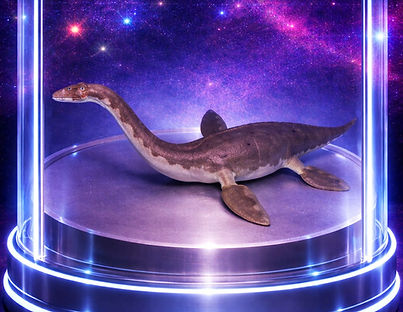
🦕🌊 Plesiosaur – Prehistoric Marine Reptile 🧬🌍
📊 Scientific data
Scientific name: 🧬
Plesiosauria
Period: ⏳
~201 million years – 66 million years
Location: 📍
Seas and oceans around the world 🌍
Type: 🧾
Marine reptile 🦎🌊
🧾 Description
The plesiosaur was a marine reptile 🦎 that evolved during the Mesozoic Era and was considered one of the most prominent predators of ancient times 🌊.
Its body was broad and flat 🧩, with four large, strong fins that allowed it to move efficiently in the water, similar to swimming by "underwater flight."
One of its most prominent characteristics is its very long neck, which contained a large number of vertebrae, allowing it to reach prey without moving its entire body ⚠️.
Its head was small relative to its body, but equipped with many sharp teeth suitable for capturing fish and other marine creatures 🧬.
It was an active predator, feeding on fish, mollusks, and smaller marine reptiles.
Plesiosaurs were ectothermic, but there is evidence that some maintained a more stable body temperature than typical reptiles.
Their reproduction is not completely known, but there is evidence that some species gave birth to live offspring in water and did not lay eggs.
🌍 Where is it located?
Ancient oceans and seas around the world 🌍

2
🦕🌊 Pliosaur – Prehistoric Marine Reptile 🧬🌍
📊 Scientific data
Scientific name: 🧬
Plesiosauria
Period: ⏳
~200 to 65 million years ago
Location: 📍
Seas and oceans around the world 🌍
Type: 🧾
Marine reptile 🦎🌊
🧾 Description
Body structure: A wide, hydrodynamic, teardrop-shaped body, with four strong fins that served as "oars" for fast swimming.
Head and teeth: A massive skull (which can reach the length of 2 people in working species) is equipped with very strong jaws and large, sharp teeth designed for locking and cutting prey.
Size: They ranged from medium-sized 4-5 to giants like Heliopleurodon or Pliosaurus funkei ("Predator X"), which reached lengths of 10-12 people and even more.
🌍 Where is it located?
Ancient oceans and seas around the world 🌍
%20%E2%80%93%20%D7%96%D7%95%D7%97%D7%9C%20%D7%99%D7%9E%D7%99%20%D7%A7%D7%93%D7%95%D7%9D%20Sauropterygia%20(Plesiosaur)%20%E2%80%93%20Ancient%20Marine%20Repti.jpeg)
3
🦕🌊 Atopodentatus – Ancient Marine Amphibian Reptile 🧬
📊 Scientific data
Scientific name: 🧬
Plesiosauria (order Sauropterygia)
Period: ⏳
~250 million years ago – 66 million years ago (Triassic–Cretaceous)
Location: 📍
Oceans around the world 🌍
Type: 🧾
Marine reptile 🦕
🧾 Description
The plesiosaur 🦕 was an ancient marine reptile from the group of sauropterygians, which lived during the age of dinosaurs 🌍.
Its body was perfectly adapted to life in the water 🌊, with four large fins that were used for fast and efficient swimming.
Many species had very long necks 🦴, which allowed them to catch prey without moving their entire bodies.
Its head was relatively small but equipped with sharp teeth 🦷 for capturing fish and marine animals.
It was a predator 🐟 and fed on fish, shellfish, and sometimes other marine creatures.
Unlike most reptiles, it probably gave birth to live young (rather than laying eggs) in the water.
🌍 Where is it located?
Ancient oceans around the world 🌍

4
🦖🟠 Dilophosaurus – a carnivorous dinosaur with a collar 🧬🌍
📊 Scientific data
Scientific name: 🧬
Dilophosaurus
Period: ⏳
~193 million years ago (Early Jurassic)
Location: 📍
North America 🌍
Type: 🧾
Predatory dinosaur 🦖
🧾 Description
The Dilophosaurus 🦖 was an early carnivorous dinosaur that lived during the Jurassic period 🌍.
Its body was light and fast 🏃, with strong hind legs that allowed it to run and hunt prey.
One of its most distinctive features is the two ridges on its head 🦴 (its name means "lizard with two ridges").
In some representations (like the model here) a colorful collar 🟠 appears that opens around the neck, but this is an unscientific representation ⚠️.
It had sharp teeth 🦷 and fed on small animals.
It was an agile and active predator, living in terrestrial environments.
🌍 Where is it located?
North America 🌍
%20%E2%80%93%20%D7%96%D7%95%D7%97%D7%9C%20%D7%9E%D7%A2%D7%95%D7%A4%D7%A3%20%D7%A7%D7%93%D7%95%D7%9D%20Pterosaur%20(Pteranodon)%20%E2%80%93%20Ancient%20Flying%20Reptile.jpeg)
5
🦕🟠 Pterosaur (Pteranodon) – Ancient Flying Reptile 🧬🌍
📊 Scientific data
Scientific name: 🧬
Pteranodon (Pterosauria group)
Period: ⏳
~86–84 million years ago (Cretaceous)
Location: 📍
North America 🌍
Type: 🧾
Flying reptile 🦕
🧾 Description
The Pteranodon 🦕 was an ancient flying reptile from the pterosaur group, which lived during the Cretaceous period 🌍.
Its body was adapted for flight ✈️, with large wings made of a membrane of skin stretched between the long fingers.
It had a long, toothless beak 🦴, which it used to catch fish from the water.
Its head was characterized by a large posterior protrusion 🧩, which may have aided in balance during flight.
It feeds mainly on fish 🐟 and lives near seas and oceans.
He was an excellent glider who knew how to take advantage of air currents to fly great distances 🌬️.
🌍 Where is it located?
North America 🌍

6
🦖🟢 Coelophysis – an ancient and agile predatory dinosaur 🧬🌍
📊 Scientific data
Scientific name: 🧬
Coelophysis
Period: ⏳
~210–200 million years ago (Late Triassic)
Location: 📍
North America 🌍
Type: 🧾
Predatory dinosaur 🦖
🧾 Description
The Coelophysis 🦖 was a small, agile carnivorous dinosaur that lived during the Triassic period 🌍.
His body was thin and light, with long legs that allowed him to run at high speed.
Its neck was long and flexible 🦴, which helped it capture prey quickly.
His hands were small but with sharp claws ⚠️, which were used for grasping.
It feeds on small animals 🐟 and possibly also carrion.
Considered one of the first dinosaurs to evolve.
🌍 Where is it located?
North America 🌍

7
🦕🟠 Quetzalcoatlus – Giant Flying Reptile 🧬🌍
📊 Scientific data
Scientific name: 🧬
Quetzalcoatlus
Period: ⏳
~70–66 million years ago (Late Cretaceous)
Location: 📍
North America 🌍
Type: 🧾
Flying reptile 🦕
🧾 Description
The Quetzalcoatlus 🦕 was one of the largest flying creatures that ever lived 🌍.
Its wings were enormous ✈️, with a wingspan that could reach about 10 meters.
Its body was relatively light 🧩, with hollow bones that allowed it to fly despite its size.
It had a long, toothless beak 🦴, which was used to capture prey.
Feeds on small animals 🐟, possibly also carrion.
He was also able to walk on the ground and take off with a short run ⚠️.
🌍 Where is it located?
North America 🌍

8
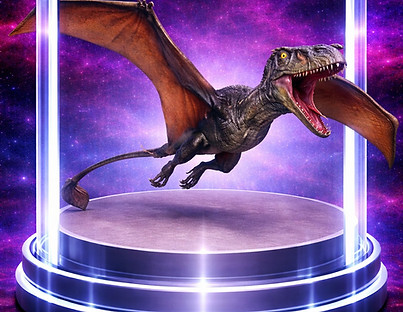
🦖🥚 Oviraptor – Smart Theropod Dinosaur 🧬🌍
📊 Scientific data
Scientific name: 🧬
Oviraptor philoceratops
Period: ⏳
~75 million years (Upper Cretaceous)
Location: 📍
Mongolia (Gobi Desert) 🌍
Type: 🧾
Theropod Dinosaur 🦖
🧾 Description
The Oviraptor 🦖 was a small-to-medium-sized theropod dinosaur from the Cretaceous period, belonging to the group of Oviraptorosaurs – dinosaurs very closely related to modern birds 🧬.
Its body was relatively light and built for fast and agile movement 🧩, with strong hind legs and two front limbs with developed claws, which were used for gripping and searching for food.
One of its most notable features is its short skull and toothless horned beak ⚠️, which suggests a varied diet. Studies suggest that it was probably omnivorous – feeding on eggs, mollusks, plants and possibly small animals.
In the past, it was believed that Oviraptor "stole eggs" (hence its name - "egg thief"), but later discoveries showed that individuals were found sitting on nests 🥚, which actually indicates developed parental behavior and incubation, similar to birds.
Its body may have been covered in feathers 🧬, which strengthens the evolutionary link between dinosaurs and birds.
Its skeletal system indicates relatively high intelligence among dinosaurs, with well-developed senses and environmental adaptability.
The Oviraptor lived in semi-desert environments, with varying conditions of heat and cold, and went extinct along with other dinosaurs at the end of the Cretaceous.
🌍 Where is it located?
Gobi Desert 🌍
9
🦇🦴 Dimorphodon – an ancient flying pterosaur 🧬🌍
📊 Scientific data
Scientific name: 🧬
Dimorphodon
Period: ⏳
~200–190 million years ago (Early Jurassic)
Location: 📍
Europe (England) 🌍
Type: 🧾
Pterosaur (flying reptile) 🦇
🧾 Description
The Dimorphodon 🦇 was an ancient pterosaur from the Early Jurassic period, and one of the first flying reptiles 🧬.
Its body was relatively small but had an exceptionally large head 🧩, with strong jaws and differently shaped teeth – a feature that gave it its name ("two-shaped teeth") ⚠️.
Its wings were made of a membrane of skin stretched between the long finger of the hand and the body, which allowed it to fly or soar.
Unlike later pterosaurs, it had a long, stiff tail 🧬, which helped with stability during flight.
It may have been a small predator, feeding on fish, insects, or small vertebrates 🦴.
Its body structure indicates that it was not a particularly sophisticated flier, but rather hovered and sometimes moved on the ground.
🌍 Where is it located?
England 🌍
Europe 🌍

10
🦎 Dictyodon 🧬🌍
📊 Scientific data
Scientific name: 🧬
Diictodon
Period: ⏳
~260–252 million years ago (end of the Permian)
Location: 📍
South Africa 🌍 (Karo Basin)
Type: 🧾
Ancient plant-eating reptile 🦎🌿
🧾 Description
The Dictyodon was a relatively small reptile 🐾
With a compact body and short head 🧩
It usually had two small, protruding tusks ⚠️
But in some details they were small or missing.
It belonged to the dicynodont group,
Ancient plant eaters that evolved greatly during the Permian period 🌿
Known for his ability to dig burrows in the ground 🕳️
Where it hid from predators and maintained a stable temperature 🌡️
🌍 Where is it located?
Dry and semi-desert areas 🌍
With soft soil suitable for digging 🕳️

10
🦖 Archaeopteryx
📊 Scientific data
Scientific name: 🧬
Archaeopteryx lithographica
Period: ⏳
~150 million years (Upper Jurassic)
Location: 📍
Germany 🌍
Type: 🧾
Ancient theropod dinosaur / ancient bird 🐦
🧾 Description
Archaeopteryx was a transitional creature 🧬
Between dinosaurs and birds
He had well-developed feathers 🪶
Similar to modern birds
Its wings were relatively strong.
And allow gliding or short flights 🌬️
However, he had teeth ⚠️
And a long, bony tail
He had claws on his wings 🦴
A very ancient feature
His body structure combines
Characteristics of reptiles and birds
Considered one of the most important fossils
Understanding evolution 🌍
🪶 Live replay
The display case displays a reconstruction of the living Archaeopteryx 🐦
The reconstruction is based on the fossils 🦴
And especially about the feather prints found
It demonstrates what the creature looks like.
When he was alive in the wild
Colors and patterns are scientific hypotheses 🎨
But the overall structure is very precise.
A combination of fossil and reconstruction
Allows for a complete understanding of the animal
🌍 Where is it located?
Tropical islands 🌴
Coastal areas 🌊
Europe 🌍
📚 Sources – Archaeopteryx
🔬 Scientific sources
Natural History Museum
https://www.nhm.ac.uk
Encyclopedia Britannica
https://www.britannica.com
📖 Studies
Wellnhofer, P.
M
10
🦖 Pterodactylus – Fossil and reconstruction
📊 Scientific data
Scientific name: 🧬
Pterodactylus antiquus pterodactylus
Period: ⏳
~150 million years (Upper Jurassic)
Location: 📍
Europe (Germany) 🌍
Type: 🧾
Flying reptile (pterosaur) 🦇
🧾 Description
The Pterodactylus was an ancient flying reptile 🧬
But not a dinosaur
His wings were made of leather 🪶
Stretched between long fingers
He had a long skull ⚠️
With sharp teeth
His neck was long and flexible.
Adapted for hunting
Feeds on fish 🐟
and small animals
Was able to fly easily 🌬️
And float over water
🦴 The fossil
The fossil is preserved in fine limestone 🪨
Similar to Archaeopteryx fossils
After his death, his body sank into quiet lagoons 🌊
And buried in fine sediments
In the fossilization process 🧬
The tissues were replaced with minerals.
Very important details have been preserved:
The long skull
The wings and fingers
These fossils are rare.
and help understand early aviation
The fossil is displayed in the display case 🦴
And next to it, a reconstruction of the flying beast 🦇
🪶 The Restoration
The reconstruction shows the Pterodactylus in flight 🌬️
Based on skeletal structure
And about scientific studies
The colors are hairs 🎨
But the structure is very precise.
The combination of fossil and reconstruction
Allows for a complete understanding of the creature
🌍 Where is it located?
Shallow lagoons 🌊
Coastal areas 🌴
Europe 🌍
📚 Sources – Pterodactylus
Natural History Museum
https://www.nhm.ac.uk
Encyclopaedia Britannica – Stegosaurus
https://www.britannica.com
📖 Studies
Wellnhofer, P.
Unwin, D.
🔥 Summary of Showcase 8
🔥 Summary of Showcase 8
This is the world ruled by vast and diverse creatures—
Who changed the face of the earth