
Astrogeomanity Museum & Academy

🌿 5. Life on Land – Plants & Insects | Transition from Sea to Land

1
🍄🌈✨ Variety of mushrooms – a hidden and diverse world 🧬🌍
📊 Scientific data
Period: ⏳
~1 billion years – today
Location: 📍
Land 🌍
Type: 🧾
Mushrooms (Mushroom Kingdom) 🍄
🧾 Description
Mushrooms 🍄🌈 come in many shapes, colors, and sizes 🧩.
There are small and simple mushrooms ⚪ and there are large and complex ones with special structures 🎨.
They are not plants ❌🌱 – they feed on decomposing organic matter 🦠.
Some are poisonous ⚠️ and some are edible 🍽️.
They reproduce through tiny spores 🧬 that are dispersed in the air.
Their role is very important in the decomposition of materials and the cycle of life in nature 🌍.
In the context of Astrogeomnity 🌌🚀, mushrooms represent connection, cycles, and renewal 🧬♻️.
🌍 Where is it located?
In forests 🌳, on the ground, on trees and in humid environments 🌍💧.

2
🌱🌿✨ Plant germination – the beginning of life 🌍☀️
📊 Scientific data
Period: ⏳
Hundreds of millions of years – today
Location: 📍
Land 🌍
Type: 🧾
Plants 🌱
🧾 Description
The germination of a plant 🌱 begins with a small seed that contains the potential for life 🌿✨.
When the seed receives water 💧, it begins to awaken and grow.
The first root goes into the ground 🧩 to absorb water and minerals.
Then a small stem rises upwards ☀️.
Over time, leaves develop 🌿 that allow photosynthesis 🌞.
This is a fundamental process in the development of life on Earth 🌍.
In the context of astrogeometry 🌌🚀, germination represents beginning, growth, and gradual development 🧬🌱.
🌍 Where is it located?
In all areas of land 🌍 where there is water and light ☀️💧.

3
🌵🌈✨ Variety of cacti – desert survival strategies 🧬🔥
📊 Scientific data
Period: ⏳
~30 million years – today
Location: 📍
Deserts and arid regions 🌵
Type: 🧾
Succulent plants 🌱
🧾 Description
Cacti 🌵🌈 appear in many different forms 🧩, each adapted to a different environment.
There are tall columnar cacti 📏 that store water in a thick stem.
There are round cacti ⚪ that reduce water loss.
Opuntia cactus (Prickly pear) 🟢 Built of flat joints to store water.
The thorns ⚠️ protect against predators and also reduce evaporation 💧.
These differences show how evolution creates a variety of solutions to a single problem – survival in the desert 🔥.
In the context of astrogeometry 🌌🚀, the variety of cacti represents creativity, adaptability, and an abundance of solutions in nature 🧬🌍.
🌍 Where is it located?
In deserts 🌵 around the world 🌍, mainly in America.

4
🌿🪰✨ Predatory plant – a clever trap in nature 🧬🌍
📊 Scientific data
Period: ⏳
~100 million years – today
Location: 📍
Tropical regions 🌴
Type: 🧾
Carnivorous plants 🌿
🧾 Description
The predatory plant 🌿🪰 uses special traps to capture insects 🧩.
The trap is shaped like a jug or funnel 🧪 filled with digestive fluid.
Insects are attracted to the color and smell 🎨 and fall inside ⚠️.
They are then digested and the plant absorbs the nutrients 🧬.
This is an adaptive solution for nutrient-poor soils 🌍.
In the context of astrogeometry 🌌🚀, the plant represents innovation, strategy, and extreme adaptation 🧬🌍.
🌍 Where is it located?
In humid tropical areas 🌴🌍, especially in rainforests.

5
🦟🧬✨ Mosquito in Amber – Science and Imagination Meet 🧬🌍
📊 Scientific data
Period: ⏳
~100–65 million years ago (Cretaceous, inspired)
Location: 📍
Ancient forests 🌳
Type: 🧾
Insects (diptera) 🦟
🧾 Description
The mosquito in amber 🦟🧬 is a famous example of the preservation of creatures in amber – tree resin that has petrified over time 🌳.
In reality, amber can preserve insects in a very impressive way 🧩.
In the movie "Jurassic Park" 🎬, the idea is that these mosquitoes stored the blood of dinosaurs 🦖.
The blood contains DNA 🧬 from which dinosaurs can supposedly be reconstructed ⚠️.
However, from a scientific perspective, DNA is not preserved intact for that long.
In the context of astrogeometry 🌌🚀, the mosquito in amber represents the connection between science, imagination, and human curiosity 🧬🌍.
🌍 Where is it located?
Amber is found in various regions of the world 🌍, mainly in ancient, petrified forests 🌳.

6
🌿🪨✨ Fossilized fern – evidence of ancient forests 🧬🌍
📊 Scientific data
Period: ⏳
~360–300 million years (coal)
Location: 📍
Dryland – Ancient Forests 🌳
Type: 🧾
Primitive plant (ferns) 🌿
🧾 Description
The fossilized fern 🌿🪨 is the imprint of an ancient leaf in rock 🧩.
During the Carboniferous period 🌍, giant ferns covered vast areas 🌳.
When the plant was buried in mud or sand ⚠️, it was preserved and became a fossil.
The fossil shows the highly detailed leaf structure 🎨.
Ferns were among the first plants to spread on land 🧬.
In the context of astrogeometry 🌌🚀, the fossil represents memory, development, and history of life 🌍🧬.
🌍 Where is it located?
Fossils are found in rocks around the world 🌍, especially in ancient areas of coal forests 🌳.

7
🐛🦋✨ Insect Reincarnation – Change and Development 🧬🌍
📊 Scientific data
Period: ⏳
~300 million years – today
Location: 📍
Land 🌍
Type: 🧾
Insects 🐛
🧾 Description
Many insects 🐛🦋 undergo a process called metamorphosis 🧬.
They start as larvae 🐛 – a feeding and growing stage.
Then we enter the pupal stage ⚪ where a profound internal change occurs ⚠️.
Finally, the adult insect emerges 🦋 with a completely different body structure.
Each stage is adapted to a different role – survival, growth, or reproduction 🧩.
This process is one of the most miraculous in the natural world 🌍.
In the context of astrogeometry 🌌🚀, metamorphosis represents change, renewal, and evolution 🧬♻️.
🌍 Where is it located?
All over the world 🌍, mainly in terrestrial areas and vegetation 🌿.

8
🦗🙏✨ Praying Mantis – A Precise and Camouflaged Predator 🧬🌿
📊 Scientific data
Period: ⏳
~135 million years – today
Location: 📍
Land 🌍
Type: 🧾
Insects (Cockroach Series) 🦗
🧾 Description
The praying mantis 🦗🙏 is a predatory insect that specializes in ambush hunting ⚡.
It has specialized front legs 🧩 that are used to capture prey very quickly.
Its body allows for perfect camouflage among leaves 🌿🎨.
It waits motionless ⚠️ until its prey approaches, then attacks quickly.
It has large eyes 👁️ that allow for precise vision.
In the context of Astrogeometry 🌌🚀, it represents patience, precision, and strategy in nature 🧬🌍.
🌍 Where is it located?
In warm regions 🌍, fields, forests and gardens 🌿.
9
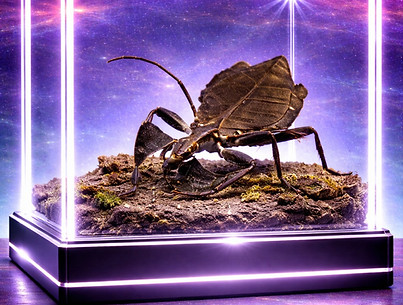
🪲🍃✨ Leaf insect – perfect camouflage in nature 🧬🌿
📊 Scientific data
Period: ⏳
~50 million years – today
Location: 📍
Tropical regions 🌴
Type: 🧾
Insects (phasmids) 🪲
🧾 Description
The leaf beetle 🪲🍃 is one of nature's greatest camouflage experts 🎨.
Its body is very similar to a leaf 🌿, including color, shape, and even "veins."
It is almost invisible to predators ⚠️ when it rests among plants.
Its movement is slow 🧩 and sometimes resembles the movement of a leaf in the wind 🌬️.
It feeds on leaves and plants 🌿.
This is a classic example of mimicry evolution 🧬.
In the context of Astrogeomnity 🌌🚀, it represents camouflage, wisdom, and blending into the environment 🧬🌍.
🌍 Where is it located?
In tropical forests 🌴🌍, mainly in Asia.
10
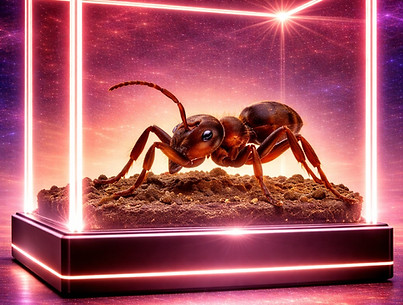
🐜⚡✨ Ant – Power in Organization and Cooperation 🧬🌍
📊 Scientific data
Period: ⏳
~100 million years – today
Location: 📍
Land 🌍
Type: 🧾
Insects (ants) 🐜
🧾 Description
The ant 🐜⚡ is a social insect that lives in large colonies 🧩.
It is capable of carrying a weight many times greater than its own weight 💪.
The ants work in precise cooperation 🧬 to build nests, gather food, and defend themselves.
Each ant has a clear role ⚠️ within the colony.
They communicate using chemicals (pheromones) 📡.
This is one of the most advanced models of organization in nature 🌍.
In the context of astrogeometry 🌌🚀, the ant represents cooperation, order, and collective power 🧬🌍.
🌍 Where is it located?
All over the world 🌍, in almost every terrestrial environment 🌿.

11
🪲🐛✨ Beetle transformation – from caterpillar to adult 🧬🌍
📊 Scientific data
Period: ⏳
~300 million years – today
Location: 📍
Land 🌍
Type: 🧾
Insects (beetles) 🪲
🧾 Description
The life cycle of a beetle 🪲🐛 includes several clear stages 🧩.
The first stage is the larva 🐛, where the insect eats and grows rapidly.
Then comes the pupa stage ⚪, in which a profound internal change occurs ⚠️.
Finally, the adult develops 🪲 with a hard body and wings.
Each stage is adapted to a different function – growth, change, or reproduction 🧬.
This is a process of complete metamorphosis 🌍.
In the context of Astrogeomanity 🌌🚀, this cycle represents change, development, and renewal 🧬♻️.
🌍 Where is it located?
All over the world 🌍, especially in soil, trees and natural environments 🌳.

12
🦂🔄✨ The life cycle of a scorpion – from larva to adult 🧬🌍
📊 Scientific data
Period: ⏳
~430 million years ago – today
Location: 📍
Dry, mainly hot and dry areas 🌵🌍
Type: 🧾
Arthropods, arachnids, scorpions 🦂
🧾 Description
The creature in the picture is a scorpion 🦂, also called a scorpion or "scorpion" by various common names.
The image shows the life cycle of a scorpion 🧬 – and not an ancient sea creature.
The female gives birth to live young 👶🦂 and does not lay eggs like many insects.
The young climb onto the mother's back 🛡️ to receive protection in the early stages of their lives.
They then gradually grow 🔄 and undergo several molts of the exoskeleton ⚠️.
At each stage, the body becomes bigger, stronger and more developed 💪.
The adult scorpion is an effective terrestrial predator ⚡ with pincers, jointed legs, and a venomous stinger at the tip of its tail.
In the context of Astrogeomanity 🌌🚀, the life cycle of the scorpion represents protection, adaptation, survival, and gradual evolution in the living world 🧬🌍.
🌍 Where is it located?
Scorpions live in deserts 🌵, rocky areas 🪨, arid areas, and hot regions around the world 🌍.

13
🪲🍃✨ Collection of insects from all eras 🧬🌿
📊 Scientific data
Period: ⏳
~400 million years – today
Location: 📍
Land 🌍
Type: 🧾
Insects (various groups) 🪲🦗🦟
🧾 Description
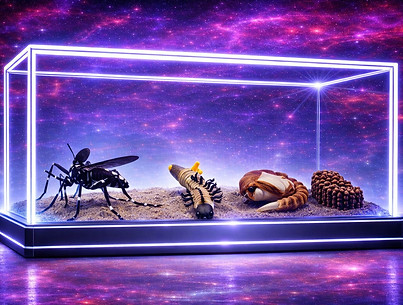
The collection in the picture 🧪🪲 includes preserved insects for research and study purposes 📚.
The insects were collected from different environments 🌍 and represent a huge variety of species 🧬.
Conservation methods allow us to study body structure, colors, and behavior ⚠️.
You can see different types – beetles, flies, cockroaches, wasps and more 🧩.
The collection assists in scientific classification and understanding the evolution of insects 🌱.
Insects are the most diverse group in the animal world 🌍.
In the context of Astrogeomanity 🌌🚀, the collection represents knowledge, documentation, and understanding of biodiversity 🧬📊.
🌍 Where is it located?
Laboratories, museums and research institutions 🌍📚.
14
🪰🔄✨ The life cycle of a yat – a complete transformation 🧬🌍
📊 Scientific data
Period: ⏳
~250 million years – today
Location: 📍
Land 🌍
Type: 🧾
Insects (diptera) 🪰
🧾 Description
The creature in the picture is a fly 🪰, and the display shows its life cycle 🧬.
The first stage is the egg 🥚, which is usually laid in an environment rich in organic matter.
Then a maggot-like larva 🐛 hatches, whose main function is to eat and grow quickly ⚠️.
Later, it transforms into a cocoon or pupa 🟤, within which a profound change in body structure occurs 🔄.
Finally, the adult fly emerges 🪰 with large eyes, active wings, and developed legs.
This is a process of complete transformation, in which each stage is adapted to a different role – growth, change, and reproduction 🧩.
In the context of Astrogeomanity 🌌🚀, the life cycle of the fly represents rapid change, adaptation, and biological efficiency in the insect world 🧬🌍.
🌍 Where is it located?
Flies live almost everywhere in the world 🌍, especially near sources of food, organic matter, and vegetation 🌿.

15
🦟🔄✨ The life cycle of a dragonfly – from water to air 🧬🌊
📊 Scientific data
Period: ⏳
~300 million years – today
Location: 📍
Fresh water and air 🌊🌍
Type: 🧾
Insects (dragonflies) 🦟
🧾 Description
The creature in the picture is a dragonfly 🦟, not a regular fly.
Its life cycle begins with eggs 🥚 laid in the water 🌊.
A nymph (aquatic larva) then develops 🧩 that swims and hunts in the water ⚠️.
This stage can last a long time, during which it grows and develops.
Finally, it emerges from the water 🔄, sheds its skeleton and becomes a flying adult dragonfly 🦟.
This is a partial transformation (incomplete metamorphosis) 🧬.
In the context of Astrogeomanity 🌌🚀, it represents a transition between worlds – water and air, and evolution between different stages 🧬🌍.
🌍 Where is it located?
Near freshwater sources 🌊 such as lakes, streams and marshes 🌍.

16
🦋🔄✨ The life cycle of a butterfly – a complete transformation 🧬🌿
📊 Scientific data
Period: ⏳
~200 million years – today
Location: 📍
Land 🌍
Type: 🧾
Insects (butterflies) 🦋
🧾 Description
The picture clearly shows the life cycle of a butterfly 🦋 🧬.
The first stage is the egg 🥚, which is laid on leaves 🌿.
A caterpillar 🐛 (butterfly caterpillar) then hatches, which eats and grows rapidly ⚠️.
The caterpillar later turns into a green pupa 🟢 (chrysalis), in which a profound change occurs 🔄.
Finally, an adult butterfly emerges 🦋 with colorful wings.
This is a process of complete metamorphosis 🧩.
Each stage is tailored to a different role – growth, change, and reproduction 🌍.
In the context of Astrogeomanity 🌌🚀, it is a symbol of profound change, renewal, and development 🧬♻️.
🌍 Where is it located?
All over the world 🌍, especially in areas with vegetation 🌿.

17
🕷️⚡✨ Tarantula – a silent predator 🧬🌍
📊 Scientific data
Period: ⏳
~300 million years – today
Location: 📍
Land 🌍
Type: 🧾
Arthropods (arachnids) 🕷️
🧾 Description
The tarantula 🕷️⚡ is a large and impressive spider with a hairy body 🧩.
It preys on insects and small animals ⚠️ using venomous fangs.
Despite their menacing appearance, most species are not dangerous to humans 🌿.
It lives in burrows in the ground or hides under rocks 🪨.
Its movement is slow but precise, and it hunts from ambush 🎯.
The tarantula also uses hairs for self-defense 🧬.
In the context of Astrogeomanity 🌌🚀, it represents patience, strength, and control over the environment 🧬🌍.
🌍 Where is it located?
In warm regions 🌵, forests and dry areas around the world 🌍.

18
🕷️🎭✨ Peacock Spider – Color, Dance and Communication 🧬🌈
📊 Scientific data
Period: ⏳
~50 million years – today
Location: 📍
Land 🌍
Type: 🧾
Arthropods (Jumping Spider) 🕷️
🧾 Description
The peacock spider 🕷️🎭 is one of the most colorful spiders in the world 🌈.
The males display a colorful pattern on their abdomen ⚠️ that opens like a fan.
They perform an impressive courtship dance 💃 to attract females.
Their eyesight is very sharp 👁️ and they use it for communication.
This is a jumping spider 🧩, capable of jumping with great precision.
His behavior is a fascinating example of the evolution of visual communication 🧬.
In the context of Astrogeometry 🌌🚀, it represents expression, color, and intelligence in communication 🧬🌍.
🌍 Where is it located?
Mainly in Australia 🌏, in warm continental areas 🌿.

19
🪲💩✨ Dung beetle – nature's engineer 🧬🌍
📊 Scientific data
Period: ⏳
~100 million years – today
Location: 📍
Land 🌍
Type: 🧾
Insects (beetles, grubs) 🪲
🧾 Description
The dung beetle 🪲💩 is known for its unique behavior – rolling dung balls 🧩.
She uses the ball as a food source or to lay eggs ⚠️.
The beetle can push a ball larger than its own weight 💪.
This behavior helps break down organic matter and enrich the soil 🌱.
It plays an important role in the ecosystem 🌍.
She has a very developed sense of smell for finding food 🧬.
In the context of astrogeometry 🌌🚀, it represents cycles, cleansing, and renewal in nature 🧬♻️.
🌍 Where is it located?
All over the world 🌍, especially in areas with terrestrial animals 🌿.
🔥 Showcase 5 Summary
Life is not just about surviving —
They adapt themselves and change the world.
The display invites you to:
👉 Understand how life emerged from water
👉 And how did they start shaping the surface of the Earth?